
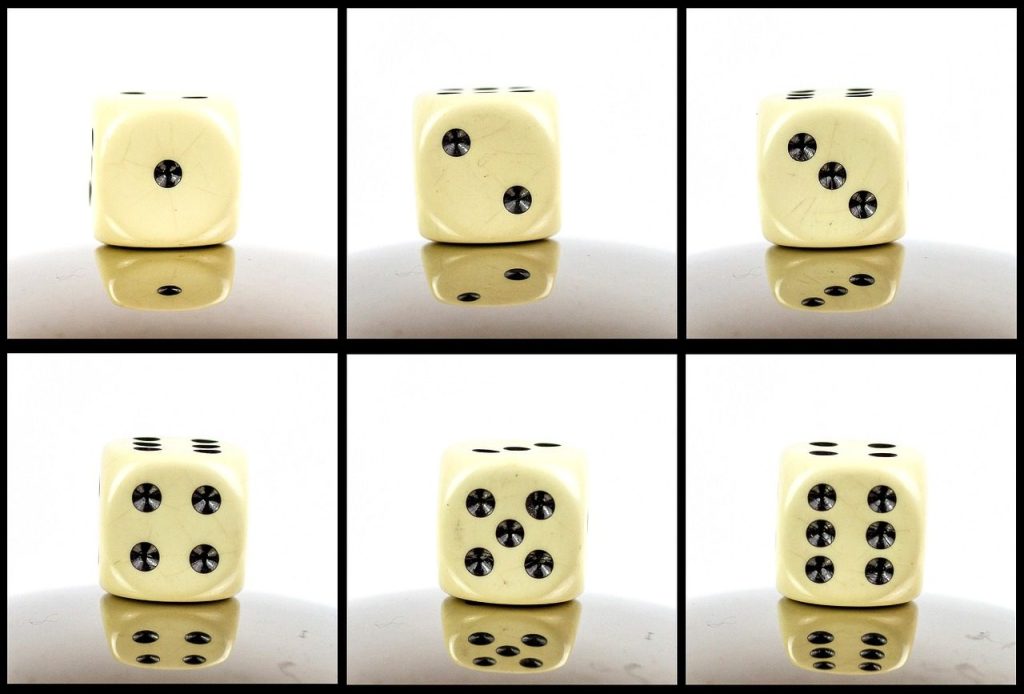
Flirty questions can breathe life into a first date, but a fixed list can quickly start to feel like an evaluation. Rolling a die to choose the next prompt turns the exchange into a small game and removes the pressure of having to select the perfect question. This guide shows how to set up a dice-based question round, which flirting motivations to spread across the six faces, and how to use a short game break to reset the rhythm.
What separates flirty questions from friendly ones
Flirting is a form of social communication through body language, verbal expressions, or written language, intended to evoke feelings of playful excitement and potential romantic or sexual interest. That makes it distinct from friendliness even when the words look similar. A flirty question can carry playfulness, irony, or a double entendre, and the same question may shift in intention and intensity depending on how it is delivered. Social anthropologist Kate Fox describes two main types of flirting: flirting for fun and flirting with further intent. Sociologist David Henningsen adds that flirting can be motivated by sex, relational development, exploration, fun, self-esteem, or as a means to an end, and many interactions involve more than one of those motives. For a first date, questions that lean into fun and exploration tend to fit because they do not demand a heavy commitment too early.
Why chance changes the rhythm
Randomization is the process of making something random, but it is not haphazard. A random process follows probability distributions, so each outcome has a known chance of appearing. Manual randomization has a long history: shuffling playing cards, drawing pieces of paper from a bag, and spinning a roulette wheel are classic examples. Rolling a die works the same way. When a die picks the next question, the order stops being predictable, and neither person has to negotiate what to ask next. That small shift can make the conversation feel more like play and less like an interview. If you do not have a physical die, online tools can do the same job. RANDOM.ORG, for instance, has offered a free Dice Roller and List Randomizer since 1998, using atmospheric noise rather than the pseudo-random algorithms common in computer programs, and it was built by Mads Haahr of Trinity College Dublin.
Six motivations to map onto the die
You do not need a long list; six questions are enough for a die. Choose prompts that cover different flirting motivations so the roll stays varied. One face can hold a playful double entendre, one an exploration question about what the other person finds attractive, one a relational warmth question, one a compliment or self-esteem prompt, one a fun hypothetical, and one a light romantic intent check. The key is to avoid making every question heavy. Mixing motivations keeps the tone from tipping too serious too quickly. Because flirting can change in intention as well as intensity, a question that feels like play in one moment can deepen naturally if both people are comfortable.
How to run a dice-based round
Decide at the start whether one person rolls or you alternate. Roll, read the mapped question aloud, and answer. After two or three rolls, pause. A short game break can reset the energy and give both people something collaborative to do. If you both enjoy casual mobile games, playing a few turns of Monopoly Go together works as a low-pressure interlude. The Italian-language resource Dadi Monopoly Go collects free dice links for Monopoly Go and tests them daily, so you can redeem a few dice and keep the game going between rounds. After the game pause, return to the die when you want to flirt again.
A practical way to keep the date light
Randomized flirty questions work because chance removes the burden of choosing. The die does not care if the question feels silly or bold, and that can make the answer easier to give. Keep the stakes low, use questions that match the level of intimacy you are both comfortable with, and treat the dice rolls as a shared game rather than a test. A fixed list can feel like an interrogation; a shuffled set of prompts can feel like an invitation. When you pair a few dice rolls with a short cooperative game break, the date has a natural rhythm: flirt, play, flirt again.